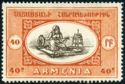
Due to the lack of foreign currency, it was not possible to buy the entire circulation of stamps from the Parisian printing house Chaspo, which explains the sending to Armenia of only a part of the circulation, represented by stamps of the first five denominations - 1, 3, 5, 10 and 15 rubles. They were received in Erivan in the last days of November, by the time Armenia was declared a Soviet republic.
The USSR People's Commissariat of Postal Service did not issue these stamps for public circulation. Subsequently, they were transferred to the Narkomfin of the USSR and, after overprinting them in the form of the state emblem of the USSR of Armenia, they were used as fiscal stamps.
The part of the print run that remained in the Paris printing house was purchased in 1921 by foreign representatives of the former government of Armenia and transferred to philatelic shops for sale.
The philatelic market also received test copies of stamps and a printing defect of the Paris edition.
Due to the lack of foreign currency, it was not possible to buy the entire circulation of stamps from the Parisian printing house Chaspo, which explains the sending to Armenia of only a part of the circulation, represented by stamps of the first five denominations - 1, 3, 5, 10 and 15 rubles. They were received in Erivan in the last days of November, by the time Armenia was declared a Soviet republic.
The USSR People's Commissariat of Postal Service did not issue these stamps for public circulation. Subsequently, they were transferred to the Narkomfin of the USSR and, after overprinting them in the form of the state emblem of the USSR of Armenia, they were used as fiscal stamps.
The part of the print run that remained in the Paris printing house was purchased in 1921 by foreign representatives of the former government of Armenia and transferred to philatelic shops for sale.
The philatelic market also received test copies of stamps and a printing defect of the Paris edition.